
A Robot's Writing My Solar-Dystopian Western
Welcome to the June 2026 edition of...
What I'm Into, What I'm Up To
#68
What I'm up to...
I've been using Claude.ai a lot because Joanna Penn of the Creative Penn Podcast uses Claude a lot and I try to do everything she says to do (I've been listening to her podcast for a decade now and she's never steered me wrong).
She also says it's worth paying for a premium subscription to Claude to get the most out of it, so I am—at least temporarily—doing that too.
I've already talked about generative AI and LLMs quite a bit and I think I've made pretty clear my mixed feelings about all of it—I really like using the tools as engines of creative experimentation and to do the things I don't like and help me with the things I do like, BUT I'm slightly terrified of their short-term effects on the world and humanity.
I'm a little suspicious of anyone who doesn't have mixed feelings about all of it, to be honest.
If you are tired of hearing about AI, you might want to skip this section. Although, if you are tired of hearing about it without having given it an honest try, then I think you should stick around.
Here's a screenshot of the projects I currently have going on in Claude right now.
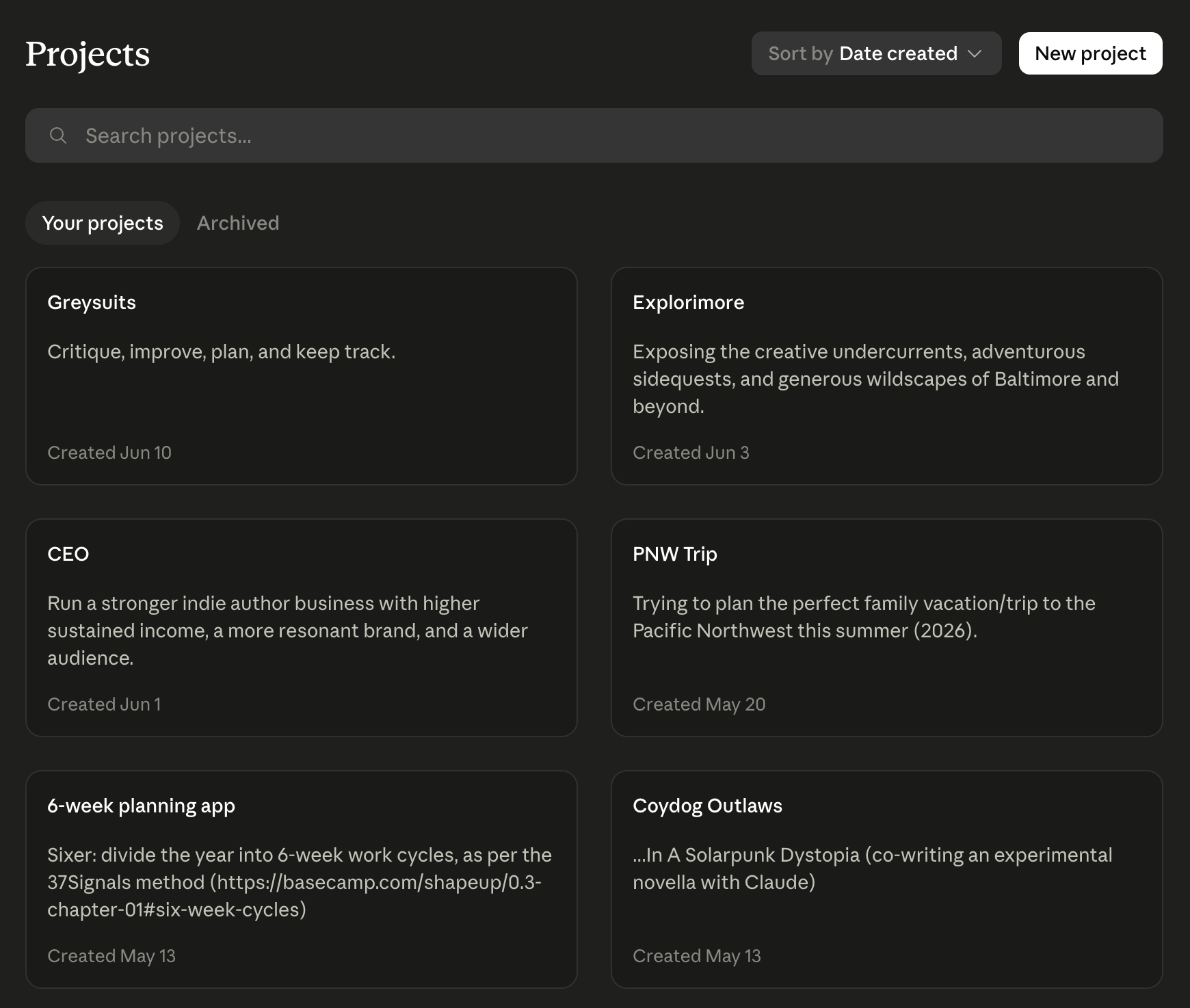
Bunch of stuff going on here, but I will focus on the current fiction-writing project.
In the bottom right corner of that image, you'll see the current story I'm working on—Coydog Outlaws. It's a working title, but I kind of like it.
As the project description says, I am cowriting this story with Claude.
I wrote the first couple chapters to get a feel for the story and main character, then I uploaded that to Claude with some info on what kind of story I wanted it to be and what kind of world I was writing in.
I asked it to give me some ideas for the next chapter, then I told it what I liked from its ideas and asked it to generate the next chapter using my style and voice.
It's pretty good at coming up with ideas and writing chapters, not so good at doing it in a style and voice that feels to me like something I would have written. It does a lot more explaining than I do, and I guess because it's trying to follow the style of a classic western, it adds a lot of phrases like, 'he did it the way a man who had just lost everything would do it'.
Here's an example from the current chapter I'm working on of 'raw Claude' writing without any edits:
And Veritable, watching, saw Sarge feel the weight of all those faces turn toward him at once, and saw — for the first time all night — the warmth slip.
'Enough,' Sarge said.
Just the one word, and it came out wrong. It came out hard. It came out like a man and not like a prophet, and Veritable saw two hundred and sixty people hear the difference.
'Take the girl,' Sarge said, to his soldiers, and his hand was not open now, it was pointing. 'She's not well. The world got into her. Take her somewhere quiet and I'll tend to her myself.' His voice was rising and he could not seem to stop it rising. 'The rest of you, this is the test. This is the night I told you would come. Get to your blocks. Now.'
And that — the now, the bark of it, the prophet shouting like a foreman — was the thing that snapped Miranda's head up.
Veritable saw it happen. Saw the words Sarge had buried in her an hour ago, you never left me, you just rebuilt me smaller, saw them stop working, all at once, because the man who'd said them so gently was now standing in his own field yelling at frightened farmers to go to their rooms. The calm had been the whole spell. The calm had been the proof. Take the calm away and he was just a man who sold guns and called it love.
To me, this feels like overindulgent narration—like, instead of showing the reader clues to what characters are thinking and feeling and trusting them to work it out, it's hitting the reader over the head with everything that's happening in a character's mind. Some people might like this kind of storytelling. I do not—unless its for humor.
Anyway, I take the rough draft chapter it has generated and I comb through it, trimming the fat and adding my own flourishes, and then I upload it as a project file.
I tell Claude I have uploaded it, ask it to read my version and all the other chapter files and the project instructions (which are notes about the story and characters and world which I asked it to generate once we had gotten a little ways into the story), then ask it what some creative and compelling options might be for the next chapter.
Rinse and repeat.
What's been interesting about this process is a few times along the way I've had really strong 'gut feeling' direction changes. Not like, 'hmmm, I wonder what it would be like if...' but 'oh, I suddenly realize I definitely want this character to be more like this.'
In that case, I tell Claude about the change of direction and I tell it that, going forward, we're going to use this new direction so it should update the project instructions and assume the story has been going that way the whole time. But I don't go back and make those changes in the moment because—
a.) I don't want to lose momentum by going back and reworking old stuff before the story's finished, and
b.) there will probably be other things that need to change in those earlier chapters so why not just take care of it all when I go back to do the final edits and rewrite.
I told my friend Chris, who has talked about writing sci-fi and fantasy stories someday, this could be a huge leg up for a first-time novelist to put together a good story pretty quickly and then get constructive feedback and fine tune the story without having to go through the years-long process it usually takes a first time author to finish their first precious book.
But, at the same time, I'm not so sure.
Like, if I were to try to do Chris's job of analyzing tons of data for hospitals and summarizing it and pulling out the necessary bits, you could give me all the AI assistance in the world and I still wouldn't even know where to begin because I never learned the job from start to finish and never built the foundational skills to even know how to use AI's help to make the job easier.
I also told him, yes, it does feel like cheating to write a book this way—IF you think of yourself as a writer of stories. Because, ultimately, I am delegating what some would think of as the most important part of the writing job—the writing.
BUT, if I instead think of myself as a composer or director or publisher of good stories, then it's not about the writing, or the act of writing—it's instead about the finished product and whether or not people find it entertaining and compelling and resonant.
Also, would this specific story I'm working on exist without me and my involvement in it? Without a doubt, it would not.
So, that's what I'm working through right now. Is it worth using AI to this extent if it helps me get all the stories I want to tell done and out into the world that much quicker? How much AI can or should I incorporate into the process of telling stories before I might as well not be involved anymore?
And that—me not being involved at all as an author—is also a real possibility as the large language models evolve.
When it gets to the point one of them is specifically built to tell great stories, a reader could tell the LLM, 'Give me a sci-fi heist novel, Ocean's 11 vibes, set in a near-future Harpers Ferry after the climate's gone sideways and the government's failing. Throw in a cult, a little romance, keep it novella-length, and write it in the style of Nathan Lee Green (or Frank Herbert or Ernest Hemingway or fill_in_the_blank). Ok, go!'
Then, as readers, none of us will actually need authors anymore. And technically, after the LLM generates that amazing-sounding story, the reader could share it with the world and take credit for it as their creation.
Pretty crazy, right?
But for now, I'm having fun with this process and learning and, I think, continuing to grow as an author through my collaborations with robots.
What I'm Into...
- The F1 race in Barcelona last week was pretty epic. Lewis Hamilton won his first grand prix with Ferrari and the world went wild.
- The Art of Gathering: How We Meet and Why It Matters by Priya Parker—super helpful book for anyone who invites people to get together for any reason.
- Ender's Game by Orson Scott Card—a sci-fi classic that seemed worth a re-read. It's going on vacation with me.
- Flight Volume #3 edited by Kazu Kibuishi—a graphic short story collection, beautiful and imaginative.
- Running Point season 2—I don't really watch sports (except F1), but sitcoms about sports I can watch all day.
- Clarkson's Farm season 5—still funny, still fascinating, still one of my favorite things to watch.
- Marty, Life Is Short documentary—sad, happy, and interesting. Made me want to find a core group of famous friends to hang out with on a lake.
- Father Of The Bride—because of the above documentary.
- Dune: Part 2—This is my second time watching the second one. I feel like I'll be rewatching these movies quite a bit over the course of my life.
Thanks for reading! I'm off to the Pacific Northwest to show my kids what young mountains look like.


Member discussion